




Two sorts of car end up on this page: one with a light on the dash that still drives perfectly well, and one that hasn’t moved off the street outside the house for weeks. Neither has to arrive under its own power, because the recovery truck is ours. The workshop is on the Medway City Estate here in Rochester, a diagnostic is £69, and that buys an hour of a technician’s time working back to the cause rather than a code read out to you at the counter.


The bookings that come in tend to start with one of these descriptions:
You don’t need to work out which one it is first. That’s the part you’re paying for. Book it in and bring it to the Medway City Estate in Rochester, and if the light that’s on is the oil pressure warning and the engine is a 1.0 EcoBoost or a 1.2 PureTech, drive it as little as you can until it’s with us.
If it won’t start, is stuck in limp mode or has been standing outside the house for months, don’t try to get it here. We run our own recovery truck rather than arranging one through somebody else, and the minimum call-out charge for recovery is £80. A car that died on a residential street is the normal beginning of a fault-finding job, not an awkward exception, and the diagnosis effectively starts when the technician watches how it behaves going onto the winch. When you ring you’re talking to the workshop, not a call centre, and not a form that goes out to three garages for you to sort through.
Most diagnostics are done the same day. Deeper fault finding isn’t, because a fault that only shows itself under load or after a few miles has to be driven before it can be found, and a road test can’t be squeezed into a slot to suit the diary. The order of the job is the same either way, and nothing is spent until you’ve been told what the fault is and agreed to the work.
Step 1: What the car does, in your words. When the fault turns up, cold or warm, at idle or under load, whether a restart clears it, and what somebody has already replaced for it. Knowing what’s been changed already is worth more workshop time than anything else you can tell us.
Step 2: Reading the car on the OBD port. Stored codes, pending codes, and the freeze-frame the ECU kept from the moment the fault logged, which shows engine temperature, load and revs at that instant. That tells us where to look. It doesn’t tell us what to replace.
Step 3: Testing the circuit. Live data with the engine running, readings held up against what that engine should be producing, and the wiring, earths and connectors on the circuit the code pointed at checked before any part is condemned. Anything that only appears under load or after a few miles gets a road test.
Step 4: The findings, in plain words. What the fault is, what caused it, what putting it right involves, and an honest view of whether it’s worth doing on that particular car. Being told to leave it alone is a legitimate result of a diagnostic, not a wasted one.
Step 5: The price, before anything is touched. Parts, labour and how long the car needs. Where you book the repair in with us the £69 is usually credited against it; it’s job dependent and not automatic on smaller jobs, and we’ll tell you which way it falls before you commit rather than after.

A stored code tells you which circuit reported something out of range. It doesn’t tell you which part failed. An ABS code names a wheel, and behind that wheel sit a sensor, the reluctor ring the sensor reads, and a length of wiring that has flexed every time the suspension has moved for the last ten years. Fit the sensor the code named and there’s a fair chance the light is back within the week.
So we read the codes and the freeze-frame, then we test. Live data while the engine runs, sensor readings compared with what that engine should be showing, the circuit checked rather than the code trusted. Most of the time that ends in a clear answer: this is the fault, this is what it takes to fix. Where it can’t yet, you’ll be told what has been ruled out and what still has to be driven to be found, which is a different thing from a guess.
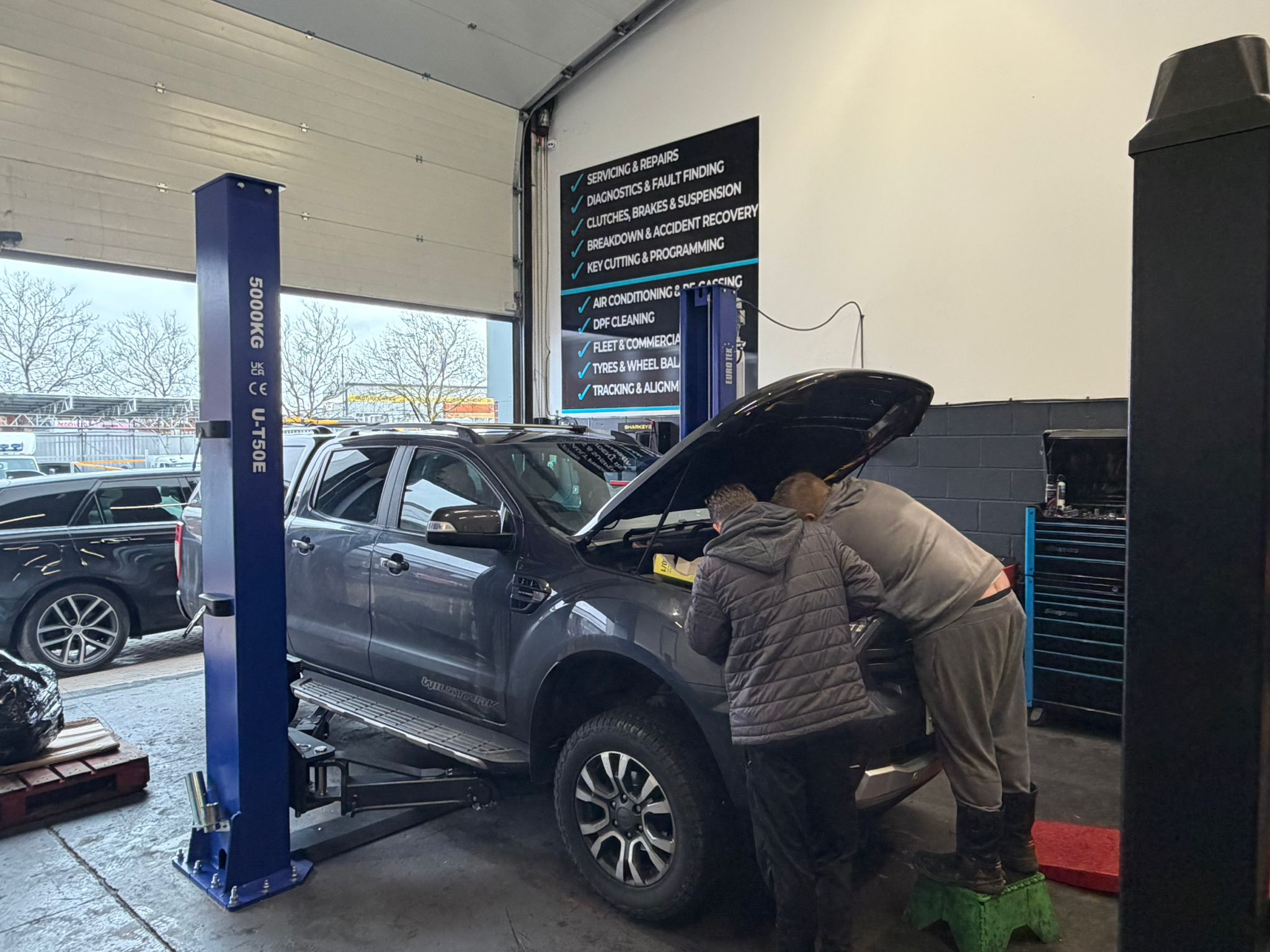
Fords, Peugeots and Citroëns make up most of the work, and it’s one shared design that brings them in. Ford’s 1.0 EcoBoost and PSA’s 1.2 PureTech both run the cambelt inside the engine, sitting in the oil. As the belt ages it sheds material into the sump, the debris blocks the oil pickup, and an engine starved of oil pressure doesn’t survive it for long. Caught early, when there’s a rattle from cold or an oil level nobody can account for, it’s a belt job. Caught late it’s an engine. We replace wet belts here, so a diagnostic that finds one doesn’t have to go anywhere else.
Diesels arrive with DPF and EGR faults, and the cause is usually the driving rather than the car. Short runs around town never get the exhaust hot enough to finish a regeneration, soot load climbs, back-pressure rises and the car drops into limp mode. We clean and restore DPFs rather than removing them.
The rest is suspension and running faults. Wheel bearings and shock absorbers, and the knock or rumble on a rough surface that nobody can pin down. Misfires where a coil or a set of plugs has already gone in and the fault is still there. Lights that come on, go out and never appear when you want them to. Electrical work too: ABS, airbag, immobiliser, and a battery that flattens over a few days because something is still drawing current with the key out.
Age is no reason not to look. All makes come in, including older cars a main dealer would rather not have on the ramp, and plenty of people write off a fifteen-year-old car as not worth diagnosing when an hour of testing is all that stands between it and a few more years. If the honest verdict is that the repair costs more than the car is worth, you’ll get it straight; We Buy Broken Fords is a sister business for the owners that turns out to be the answer for. Rochester is this workshop’s own town, and Strood, Chatham, Gillingham and Rainham are a short run in.
£69, and that pays for an hour of a technician's time rather than a scan. The hour covers stored and pending codes, the freeze-frame data, live data with the engine running, testing the circuit involved, and a road test where the fault needs one. There's no free code read here, because reading the code is where the job starts, not what finds the cause.
Usually, yes, where the repair is booked in with us. It's job dependent though, and not automatic on smaller jobs, because on some of those the diagnostic time is most of the work. We'll tell you which way it falls before you agree to anything, so it isn't a surprise when the invoice appears.
Yes. The recovery truck is ours, so there's nobody else to book, and the minimum call-out charge for recovery is £80. It doesn't matter whether it won't crank, won't fire, sits in limp mode or hasn't moved for months. Tell us where it's parked and how it behaved the last time it ran.
The diagnostic is done at the workshop on the Medway City Estate. Fault finding needs the ramp, the test equipment and somewhere to road test the car, and a good part of that isn't possible at the kerb. If the car can't get to us under its own power, we'll bring it in on our own truck.
That's a regular booking here. Tell us what was replaced and we'll test the circuit rather than read the same code and reach the same conclusion. Sometimes the original part was fine and the trouble is in the wiring or an earth behind it, and sometimes there are two faults and only one has been dealt with.

Phone: 01634 510 780
Email: bookings@medwayvehicleservices.
co.uk
Unit 3 Cliffe Yard, Anthonys Way, Medway City Estate, Rochester, Kent, ME2 4DY
WhatsApp us