





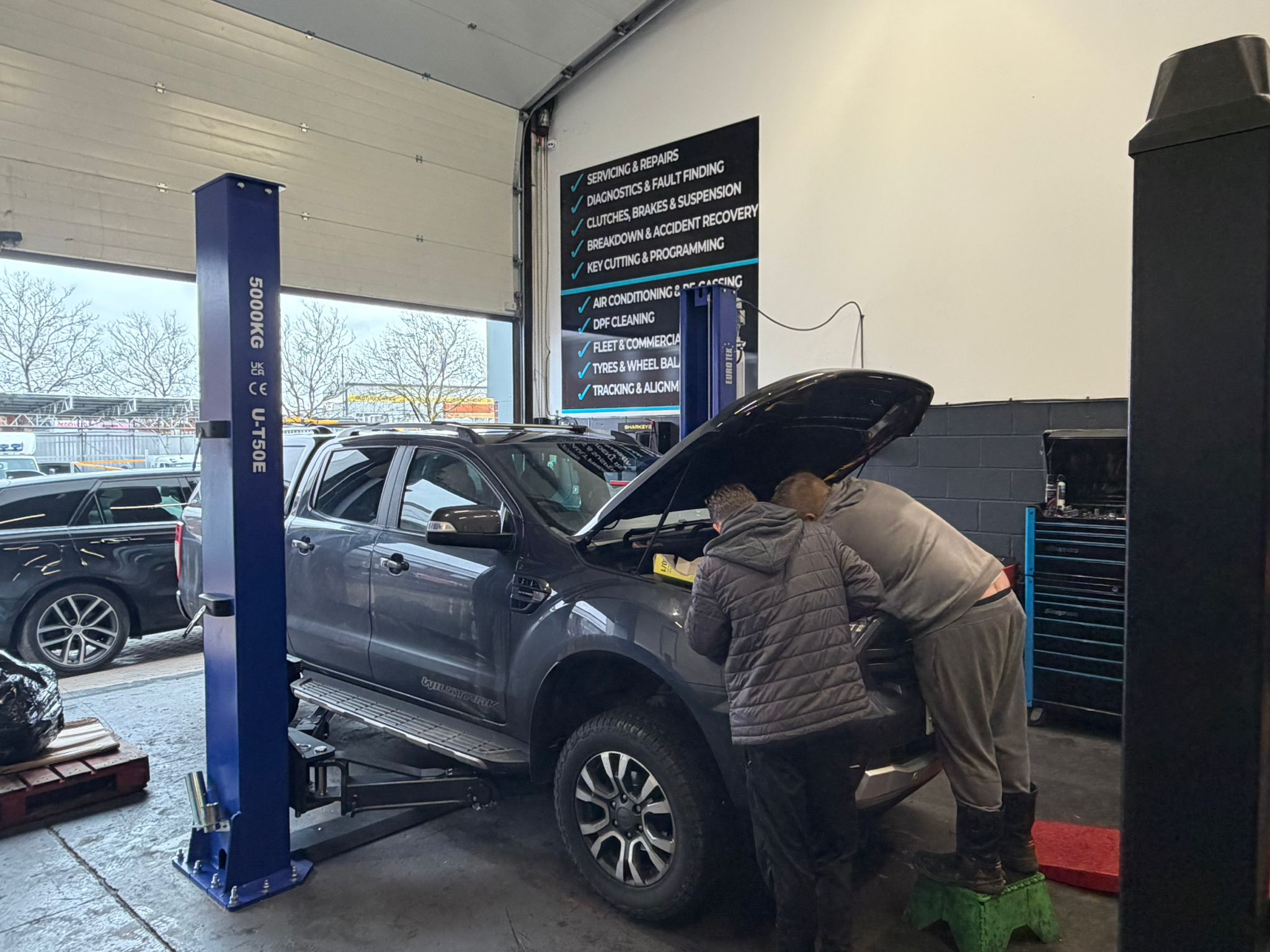
A Discovery 5 that’s misfiring, dropping into limp mode, losing power without warning or refusing to start, and a quote from somewhere with a four figure number on the end of it: that’s usually the point people ring us. Fault finding here is £69, worked from what the car is doing rather than read off a code, at our workshop on the Medway City Estate in Rochester.
If it won’t drive in, we’ve got our own recovery truck and can bring it to us. Where you book the repair with us the £69 is usually credited against it. That’s job dependent rather than automatic on smaller jobs, and we’ll tell you which way it falls before you commit to anything.


Engine work on a Discovery usually starts with one of these, and not one of them names its own cause:
You don’t need to work out which of those it is before you book. Working it out is the job you’re paying for. If there’s an oil pressure warning or a knock, though, drive it as little as you can between now and then, or let us fetch it, because that sort of fault gets worse in miles rather than in days.
One thing worth saying to the diesel owners. There’s a separate page on this site that goes through soot load and regens properly, so the short version: a blocked filter gets cleaned and restored. We don’t remove it, we don’t delete it, and the work stays inside UK law. If somebody has already offered you a delete, we’re not the garage that’ll do it.
It runs in the same order whether the light has been on for a year or the engine cut out on the driveway last night. You’ll know what failed and what caused it before you’re asked to spend anything on putting it right.
Step 1: Your account of it. When the fault appears, cold or hot, idling or under load, whether a restart clears it, and what somebody else has already fitted for it. That last answer narrows things down faster than anything we can read off the car.
Step 2: Codes off the OBD port. Stored and pending codes, plus the freeze-frame the ECU kept from the moment the fault registered, which gives us engine temperature, load and revs at the time. Useful, but that’s the beginning of the work.
Step 3: Testing, not assuming. We watch live data while the engine runs, compare sensor readings against what they should be, and test the circuit the code pointed at instead of swapping the part on the end of it. Most diagnostics are same-day. Deeper fault finding isn’t, because a fault that only shows itself under load or after a few miles has to be driven until it appears, and a road test can’t be rushed to suit the diary.
Step 4: What we found, in plain words. The cause, what putting it right involves, and a straight view on whether it’s worth doing on a car of that age and mileage. On engine work that sometimes means telling you to stop spending. That’s a legitimate answer, not a wasted diagnostic.
Step 5: Repair or replace, priced. If the engine itself has gone, a used or reconditioned unit supplied and fitted runs from around £2,500 to £6,000. Where it falls in that range is mostly the cost of the engine: a used unit is the cheaper end, a reconditioned one the dearer. It’s a range and not a quote. Nothing gets ordered and nothing gets started until you’ve seen the figure for your car and said yes to it.

A code records which circuit reported a problem. It doesn’t say why. A misfire code names a cylinder and stops there: it could be the coil, the plug, an injector, compression down on that one pot, a chafed wire, or a leak upstream of the sensor that flagged it in the first place. Fit whatever the code appears to point at and you’ve bought a part, not a repair.
Limp mode works the same way. It’s the ECU protecting something it has decided is at risk, so the fault sitting behind it can be air, fuel, boost, an EGR valve stuck where it shouldn’t be, or a sensor telling lies. That gap between reading a car and diagnosing one is the whole of what the £69 buys.
If the Discovery won’t start, sits in limp mode or has been standing on a drive for months, we can bring it in on our own truck. Not a recovery firm we phone on your behalf: our own vehicle, arranged by the people who’ll be working on the car. Tell us where it is and how it’s parked when you get in touch and we’ll tell you what we can do.
Most of the work comes from the Medway towns, Chatham, Gillingham, Rochester, Strood and Rainham, and a fair bit of it from owners who drive further into the workshop from elsewhere in Kent because they’d rather hand the car to a garage than submit the job to a network and wait.
There’s one unit and one team here. You speak to us directly rather than to a call centre, nothing starts without your approval, and the person explaining the job at handover is the one who found the fault.

Phone: 01634 510 780
Email: bookings@medwayvehicleservices.
co.uk
Unit 3 Cliffe Yard, Anthonys Way, Medway City Estate, Rochester, Kent, ME2 4DY
WhatsApp us