





A metallic rattle for a second or two on cold start, or a quote with four figures on it and no way of checking whether the number is fair. That’s what usually brings people here.
Two things are worth knowing before you spend that money. A timing chain fault can be proved rather than guessed at, and this page explains how that’s done. And on a lot of modern Fords, Peugeots and Citroens, the part you’re being quoted for isn’t a chain at all.






A chain wears rather than expires, so the first sign is nearly always a noise rather than a breakdown. Overnight the oil drains back down into the sump and the tensioner loses its pressure, so on the first turn of the key the slack in a worn chain slaps against its guides until oil pressure comes up and takes it back up again. That’s the few seconds of rattle people describe.
When the rattle stops settling, the slack has gone past what the tensioner can pull in. A chain does give more notice than a belt, but not always enough notice, and it’s the cheapest fault on this page turning into the most expensive one if it’s left.
None of that proves a chain on its own. A cam sensor, its wiring, low oil pressure or a fuelling fault can all produce much the same picture, and nobody should be signing off a strip-down of the front of an engine because of a code somebody read out over a counter.
Our diagnostic is £69. We read stored and pending codes at the OBD port, look at the freeze-frame data captured at the moment the fault set, then watch cam and crank signals live to see whether the two are genuinely out of step or whether something else is telling the ECU they are. Part of that same check is establishing what the engine actually runs, chain or belt, before anyone prices anything.
Most diagnostics are same-day. Deeper fault-finding isn’t, because a fault that only shows under load or after a few miles has to be driven to be found, and road testing can’t be rushed into a slot. If the repair is then booked in with us, the £69 is usually credited against it. That’s job dependent rather than automatic on smaller work, and you’ll be told which it is before you commit to anything.
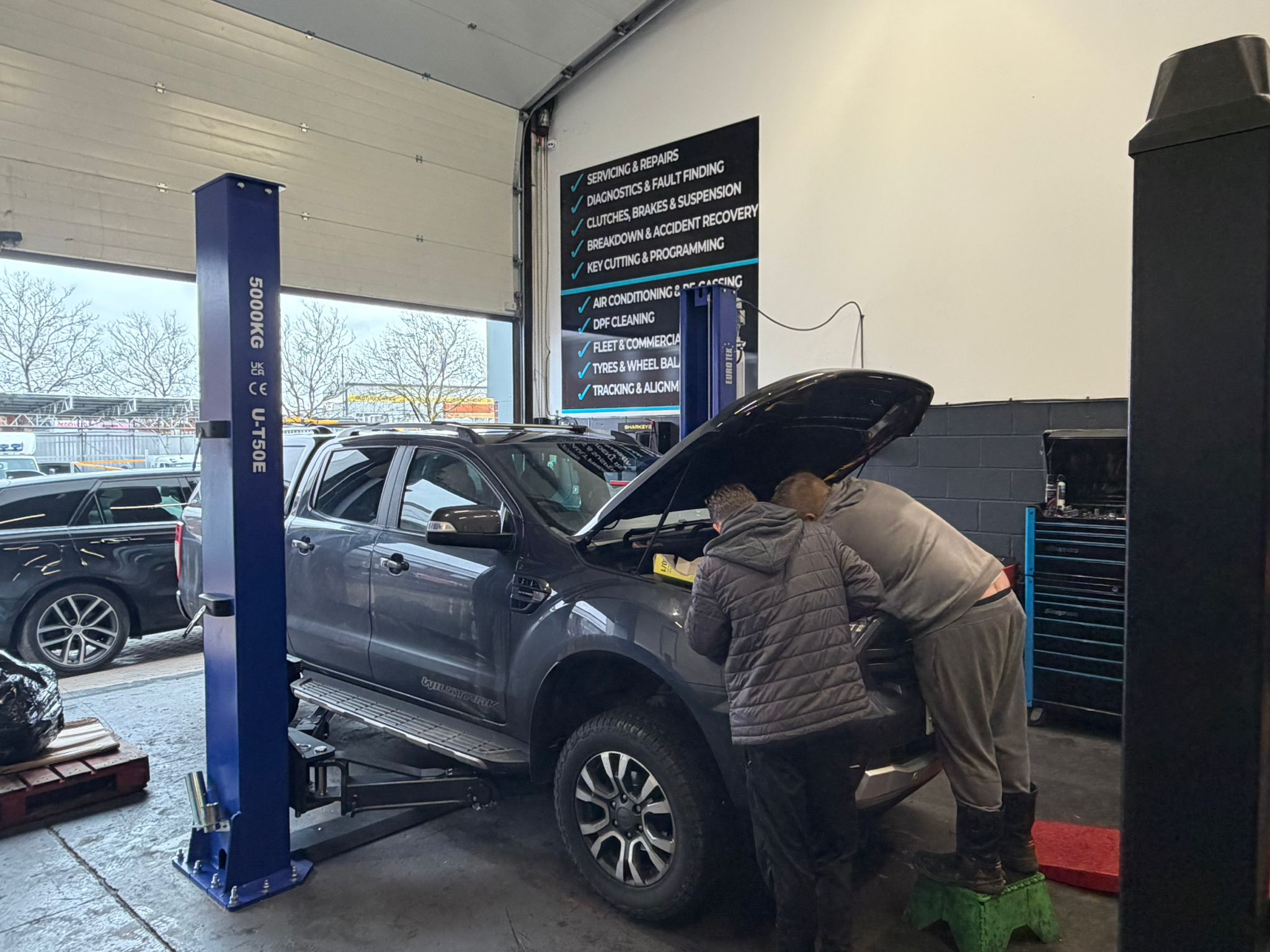
The technician who reads the codes on your car is the one who strips the front of the engine. There’s no middleman quoting on behalf of a workshop he’s never stood in, and when you ring you get the workshop rather than a call centre.
When the job’s done the timing is verified, the car goes out on the road properly before it comes back to you, and you get the findings in plain words, including anything we saw on strip that you’d want to know about. All makes are taken, petrol, diesel, hybrid and electric, including older cars a main dealer would rather not have in, which is very often exactly the car that needs this job.
It’s a big job, and how big depends on where the chain sits. Some engines run the timing drive at the front, behind the accessory belt, pulleys and covers, which means dropping the engine on its mounts or supporting it while a mount comes out to get clearance for the timing cover. Others run the chain at the gearbox end, and reaching it means separating the box from the engine before you can see anything at all. Same part, very different afternoon.
It’s also rarely just the chain. The guides are the wear surface, and as they wear they shed material into the oil, so a new chain bedding onto old guides starts stretching again almost immediately. Tensioners go the same way, and on plenty of engines the oil pump is driven off the same chain and comes apart with it. Fitting the cheap part and reusing the worn ones is a job done twice, and almost all the cost here is the labour to get in there once.

An instant figure generated from a registration is a guess dressed up as a price. What moves the real number is the engine and which end the chain sits at, how much has to come off or be supported to reach it, whether the guides, tensioner and oil pump drive go with the chain, and what turns up once the cover is off. You’ll get the figure and what it covers after the diagnosis, nothing starts without your approval, and no extras appear afterwards.
There’s one outcome worth naming. Most of these engines are interference designs, meaning the valves and pistons pass through the same space at different moments, and the chain is what keeps those moments apart. If it jumps or snaps while the engine is turning, the valves get struck and bent, and it stops being a chain job. Sometimes the honest answer is that the repair costs more than the car is worth, and we’d rather tell you that than take the work.
There are three arrangements, not two. A conventional cambelt runs dry, outside the engine, under a plastic cover, and gets changed to an interval. A chain runs inside the engine in the oil and is meant to last the life of it, which is why it’s replaced on condition rather than on a schedule. Then there’s the wet belt, a rubber cambelt running inside the engine, submerged in the oil, and it’s the one people get wrong.
Ford’s 1.0 EcoBoost and PSA’s 1.2 PureTech both use one, which is why so much of our workload is Fords, Peugeots and Citroens. As a wet belt ages it sheds material, that debris circulates with the oil and collects at the oil pickup, and once the pickup is blocked the engine is being starved while it runs. A belt job left too long turns into an engine.
So when someone rings about a timing chain rattle on a 1.0 EcoBoost or a 1.2 PureTech, the job in front of them is usually a different one with a different part, a different method and a different price. We’ve written about wet belt symptoms, cost and what happens if you keep driving on one in detail elsewhere on the site, so this page stays with chains. Which of the three you’ve got is something we establish during the diagnostic, not something anyone should assume from the badge.
We’re honest about the geography. This is one workshop on a single unit on the Medway City Estate in Rochester, just off the A289, and Orpington isn’t round the corner. It’s the A2 and M2 west to the M25 at Darenth, anticlockwise to junction 4 and down the A224, and drivers who are happy to bring the car over make that run themselves.
If the car won’t move, the recovery truck is ours. Owned, not booked through a third party, which is why we can say yes to the vehicles most collection services quietly exclude: a car that won’t start, one stuck in limp mode, or one that’s been sitting on a driveway for months since the noise got worse. A jumped chain usually means a non-runner, so this is the normal situation rather than the awkward one. Ask when you get in touch and we’ll sort the collection out with you.

Phone: 01634 510 780
Email: bookings@medwayvehicleservices.
co.uk
Unit 3 Cliffe Yard, Anthonys Way, Medway City Estate, Rochester, Kent, ME2 4DY
WhatsApp us